Emil Nusbaum, VP of Strategy, Government and Regulatory Affairs at the Automotive Recyclers Association, discusses the findings of Maryland’s Commission to Advance Lithium-Ion Battery Safety, which has delivered one of the most detailed state-level assessments of the risks and opportunities associated with lithium-ion batteries. The report sets out a practical framework for managing high-voltage vehicle batteries across their lifecycle, with a clear message for policymakers: build on the existing strengths of the automotive recycling sector while addressing emerging safety, cost and end-of-life challenges.

Maryland’s lithium-ion battery safety report sets out a practical framework for managing EV batteries across their lifecycle, concluding that policymakers should build on existing automotive recycling infrastructure while addressing rising safety risks, handling costs and weak end markets to prevent stranded batteries and support a functioning circular system.
This past year, the Maryland Commission to Advance Lithium-Ion Battery Safety submitted its final report to the Maryland General Assembly and to Maryland’s Governor, Wes Moore. In the past decade, lithium-ion batteries have become the dominant energy storage technology used in a multitude of applications, ranging from consumer electronics to vehicles and large-scale energy storage. Lithium-ion battery technology has been transformative across these technologies by reducing reliance on fossil fuels, enabling better-performing electronic devices, and changing how we drive and think about the vehicle lifecycle. That said, there are always technologies, and lithium-ion batteries present a new set of challenges that require adaptation to mitigate risks to employee health and safety, fire risk, and the general public.
Maryland, among the first states to proactively address these challenges, convened a group of twenty leading experts to study, map, and deliver concrete recommendations to policymakers and safety professionals. As chair of the Commission, I saw firsthand the operational and economic challenges recyclers face as battery volumes continue to scale.
Overview:
The Commission was given a broad mandate and a tight fourteen-month deadline to create a comprehensive study that covered:
- Best practices, standards, and guidelines to prevent, detect, and suppress lithium-ion battery fires in:
- Consumer and transportation applications
- Utility applications, including a review of the National Fire Prevention 855 Standards for Grid-Scale Storage and Safety
- Preventing, detecting, and suppressing lithium-ion fires at recycling facilities
- Reusing, recycling, and decommissioning lithium-ion batteries
- The viability of extended producer responsibility for lithium-ion batteries
- Training, education, and other information to better inform the public and first responders regarding lithium-ion battery safety
Fortunately, to assist in completing the project, the Commission comprised twenty experts representing the fire service, HAZMAT response, environmental agencies, utility providers, automotive recyclers, recyclers, battery manufacturers, and vehicle OEMs. The Automotive Recyclers Association’s VP of Strategy, Government and Regulatory Affairs, Emil Nusbaum, was selected to chair the Commission. The process of putting together the final, consensus-driven, 68-page report was facilitated throughout 19 meetings, 17 expert presentations, and four site visits.
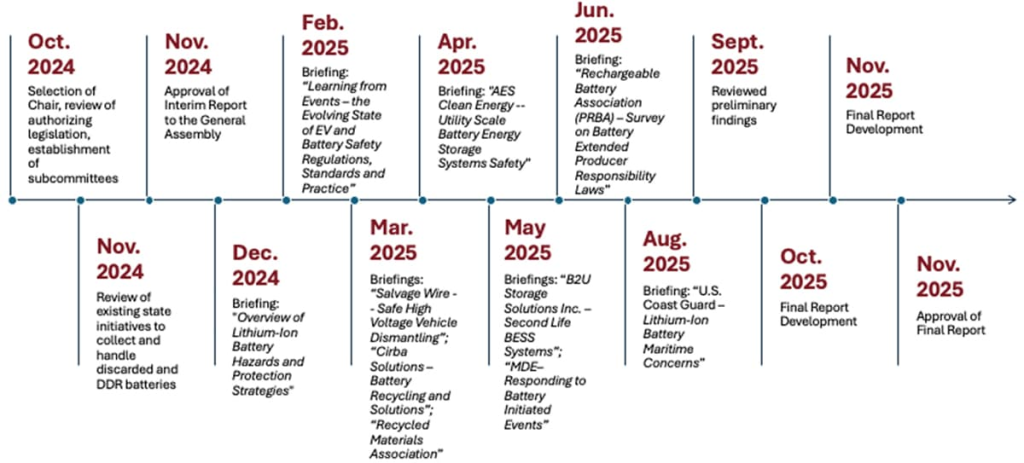
Overview of Commission Meetings
Core Findings and Recommendations for Automotive Recycling:
The Commission found that vehicle traction batteries (defined as high-voltage vehicle batteries that include hybrid, plug-in hybrid, and large-format electric vehicle batteries) require a framework that recognizes the operational realities and successes of the existing end-of-life vehicle lifecycle in the U.S. while meaningfully reducing the risks to those who are on the forefront of engaging with these batteries. In other words, the Commission recognized that automotive recyclers and the scrap recycling industry have been responsible for creating a successful circular economy for end-of-life vehicles, driven by market forces that incentivize reuse, repair, remanufacturing, and recycling.
While the Commission recognizes the successes of the existing end-of-life vehicle recycling industry, it also addresses the risks of working with high-voltage vehicle batteries, which can result in serious injury, thermal events, and environmental hazards.

The incorporation of larger, more energy-dense batteries across all vehicle classes introduces new and serious challenges for the end-of-life automotive recycling ecosystem. Due to their increasing size and capacity and the risks of thermal runaway and electrocution, vehicle traction batteries must be carefully evaluated, removed, stored, and transported prior to reuse, repair, repurposing, and recycling. In many cases, the Commission found that the costs to engage in these activities are placing substantial burdens on recyclers, commercial facilities, and state agencies.
Most alarmingly, the Commission discovered several cases of vehicle propulsion batteries being abandoned or stranded due to the lack of strong end markets for these batteries and confusion about what options battery possessors have for dealing with them. Most concerning, this issue is likely to accelerate as newer battery chemistries reduce recoverable material values and strain an already fragile end market.
To address these challenges, the Commission’s recommendations were designed specifically to work with the existing automotive recycling infrastructure, along with other business types that are engaged in working with vehicle traction batteries. Key recommendations include:
- A battery management hierarchy that incentivizes and promotes the reuse, repair, remanufacture, and recycling of vehicle propulsion batteries. This maintains the ability of automotive recyclers and scrap processors to find the best possible market for the commodities in their possession. Thereby, creating a market-driven circular economy.
- Battery transparency, where vehicle owners have the right to access battery state of health and state of charge when the battery is both within and outside of the vehicle. This information is necessary to promote safe removal, handling, storage, and transportation of batteries removed from vehicles. Additionally, this information will help to promote reuse, repair, and remanufacturing markets.
- A responsible party backstop in which the owner of a battery can request that the manufacturer collect and responsibly manage a battery when market forces fail.
- The need to maintain the ability for automotive recyclers and end-of-life vehicle processors to pursue the highest and best use of automotive components prior to triggering any backstop.
While recent regulatory changes will likely slow the adoption of electric vehicles, policymakers at the state and federal levels are increasingly looking to shape the market architecture surrounding these vehicles and batteries. States such as New Jersey, California, New York, Washington State, New Mexico, Nevada, Florida, Massachusetts, Illinois, and Hawaii are all looking to develop a framework for the management of these types of vehicles and their batteries. It is important for automotive recyclers to provide their expertise in working with end-of-life motor vehicles to promote sustainable solutions. For automotive recyclers, the message from the Commission is clear: the industry’s existing infrastructure is an asset, not an obstacle. Absent alignment between safety requirements and battery economics, the industry risks a growing stranded asset problem. The automotive recycling infrastructure is positioned to solve this problem if policies are correctly structured in a collaborative environment.
For a copy of the full Commission report, click on the following link: FINAL Commission to Advance Lithium-Ion Battery Safety in Maryland Final Report (SB 532_Ch. 949, 2024 and HB 468_Ch. 950, 2024).pdf