A milestone for automotive recyclers—and a blueprint for the rest of the country
With the signing of Senate Bill 26-003 into law on June 4, Colorado has officially enacted a comprehensive framework governing the end-of-life management of electric vehicle (EV) batteries—marking a major milestone for both the automotive recycling industry and the broader EV ecosystem. As battery chemistries change, the economics of recycling are quickly being challenged, exponentially increasing the risk that negative value batteries will become “stranded” or illegally discarded.
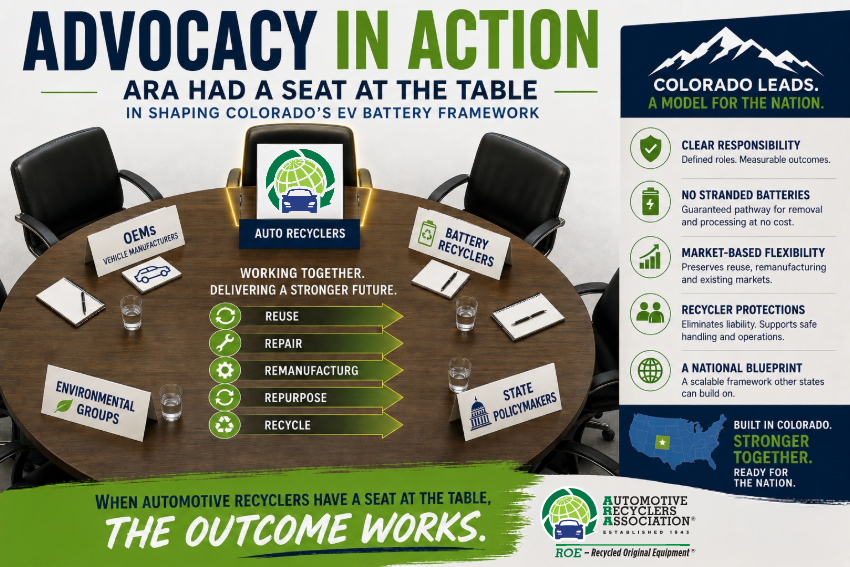
This law is the culmination of months of collaboration, negotiation, and advocacy efforts between the Automotive Recyclers Association (ARA), Battery Recyclers, Vehicle Manufacturers, industry associations, and environmental groups. It shows what is possible when industry stakeholders come together in good faith to find consensus on important issues.
Colorado’s law establishes a clear, enforceable system for managing propulsion batteries at end-of-life. At its core, the legislation establishes a non-traditional extended producer responsibility (EPR) model, that leaves in place established markets to handle most batteries while enabling automotive recyclers to send unwanted batteries back to the manufacturer at no cost.
Built on ARA’s Core Principles
“We are very proud to have worked alongside OEMs, battery recyclers, the Colorado Auto Recyclers, several of our associate members, and other stakeholders to advance our core principles on this issue critical to the future of our member businesses,” said ARA Executive Director, Vince Edivan.
The battery management hierarchy developed by ARA and Argonne National Laboratories prioritizes:
- reuse
- repair
- remanufacturing
- repurposing
- recycling
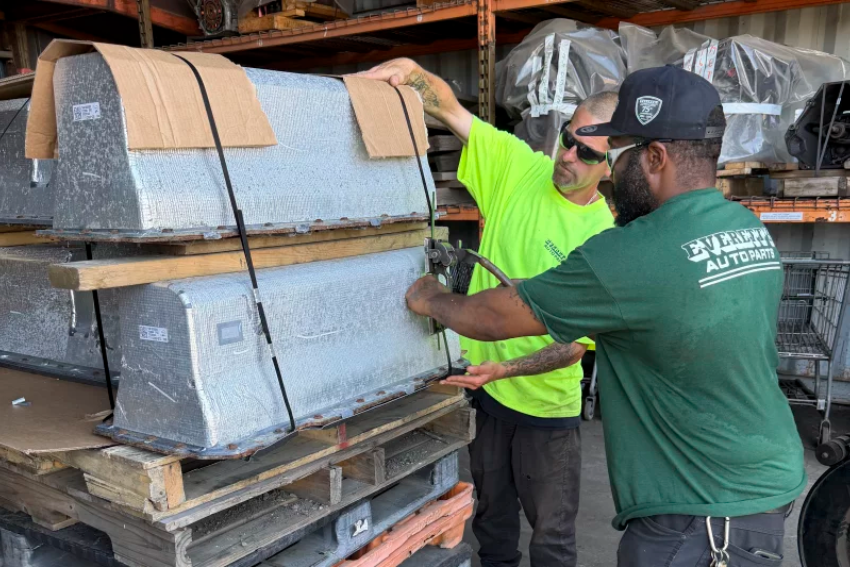
For automotive recyclers, this law addresses several long-standing risks that were rapidly emerging with EV adoption. Without a clear system, recyclers risk becoming the default storage site for batteries with no downstream market. This law eliminates any “stranded battery” liability by ensuring defined responsible parties as well as a guaranteed pathway for removal and processing
The framework also preserves the ability of recyclers to sell batteries into reuse/remanufacturing markets and avoids forced premature recycling by codifying the battery management hierarchy. Critically, recyclers can maintain market-based solutions and only use the stranded battery provisions when there is no other viable alternative.
High-voltage batteries introduce a variety of risks including fire, storage hazards, and worker safety challenges. Colorado’s system addresses these risks by creating structured collection, labeling, and handling requirements, reducing uncontrolled storage and unsafe disposal scenarios.
ARA’s involvement ensured that policymakers understand professional automotive recyclers are the first point of contact for end-of-life vehicles, with existing infrastructure that already handles hundreds of thousands of vehicles annually.
For ARA President, Shannon Nordstrom, the significance of the new Colorado law is national, offering a solution that can be replicated across the country. Federal agencies and states are actively working toward consistent EPR frameworks for batteries.
“Colorado offers a fully developed EPR framework with definitions of responsibility and measurable outcomes,” said Nordstrom. “This is something I can take to lawmakers in my home state of South Dakota, and our members can take to their lawmakers all over the country and on Capitol Hill.”
By promoting reuse, remanufacturing, repurposing and mineral recovery, the law supports conservation and domestic recovery of lithium, cobalt, and nickel, reducing reliance on new mining and foreign supply chains.
From Advocacy to Action: A Milestone Worth Noting
The foundations for this bill have been in development for nearly two years. Multiple stakeholders have discussed the underlying model from proposals in several states. Industry associations have hammered out position statements and guidelines to create a functioning ecosystem built on an existing vehicle salvage and recycling infrastructure that has evolved over the last century.
From early coalition drafting and redlines to testimony, hearings, and final passage, this effort has been a sustained, coordinated push from multiple groups. ARA has maintained a seat at the table through the process to ensure that members are represented.
“The bottom line,” said Edivan, “is that Colorado’s new law delivers exactly what the industry has been calling for: clear responsibility, market-based flexibility, protection for auto recyclers, and a model that is scalable nationwide. Most importantly, it proves that when the automotive recycling industry has a seat at the table, the outcome works.”