By Automotive Recyclers Association
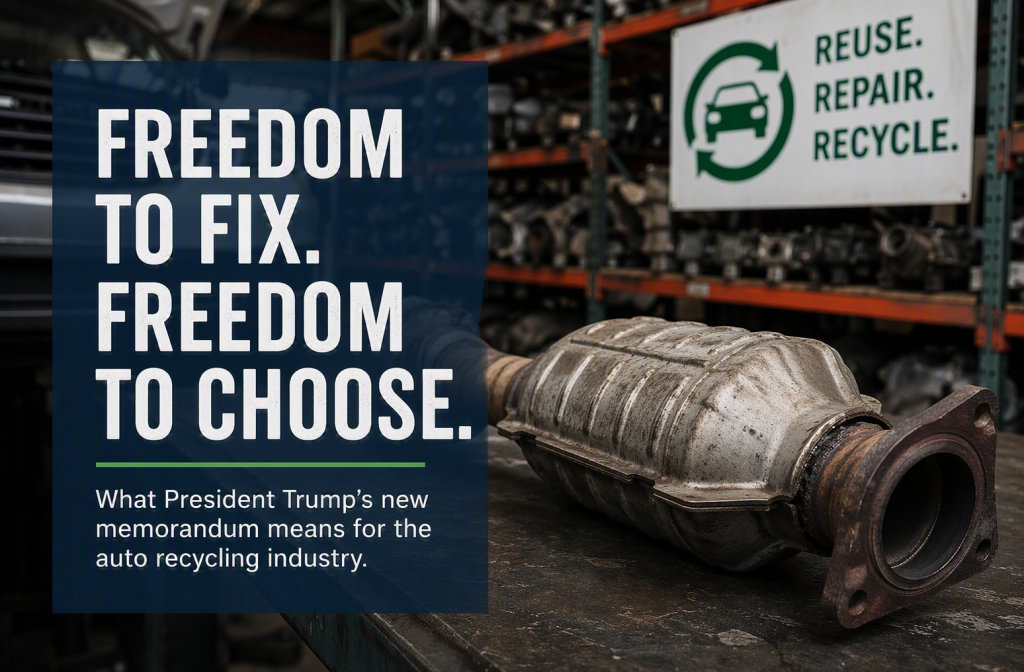
On June 29, 2026, President Donald Trump signed a presidential memorandum titled “Lowering the Cost of Living by Promoting the Freedom to Fix,” directing the Environmental Protection Agency (EPA) to take steps aimed at expanding consumers’ ability to repair their own vehicles and increasing access to aftermarket parts. While the memorandum is not a comprehensive automotive right-to-repair order, it does address several long-standing regulatory barriers that affect repairers, aftermarket parts suppliers, and vehicle owners.
For the automotive recycling industry, the memorandum signals a potentially significant policy shift toward greater acceptance of replacement parts and a broader recognition of the role the aftermarket plays in maintaining affordable vehicle ownership.
What the Memorandum Does
The memorandum directs EPA to:
- Issue guidance within 30 days clarifying what vehicle owners and repairers may legally do when conducting emissions-related repairs.
- Encourage and expedite approval of additional testing and certification pathways for aftermarket emissions-related components.
- Reduce reliance on the California Air Resources Board (CARB) certification process, which the Administration argues is overly burdensome and backlogged.
- Consider deprioritizing enforcement actions against individuals who, in good faith, attempt to repair their vehicles and return them to their original configuration.
Importantly, the memorandum does not repeal the Clean Air Act, eliminate emissions requirements, or broadly require automakers to provide diagnostic data, software access, or telematics information. It is focused primarily on emissions-related repairs and replacement parts.
Why This Matters to Automotive Recyclers
For decades, automotive recyclers have extended vehicle life and reduced repair costs by supplying quality recycled OEM parts. However, increasing complexity in vehicle systems and uncertainty surrounding emissions-related components have created challenges for recyclers, repair shops, and consumers alike.
The memorandum acknowledges that regulatory uncertainty surrounding emissions repairs can limit parts availability and increase costs. The Administration specifically cited concerns that the current certification environment restricts supply and drives up prices for compliant replacement parts.
If EPA follows through with additional certification pathways and clearer guidance, recyclers could benefit from:
Greater Acceptance of Replacement Parts
The memorandum emphasizes that consumers should be able to repair vehicles using affordable replacement parts without being viewed as circumventing emissions controls. While future EPA guidance will determine the practical effect, the philosophy expressed by the Administration aligns with the automotive recycling industry’s long-standing position that quality replacement components are essential to affordable vehicle repair.
Reduced Repair Costs for Consumers
As vehicle repair costs continue to rise, access to lower-cost alternatives becomes increasingly important. Recycled original equipment manufacturer (OEM) parts often provide a cost-effective option compared to new replacement components. Policies that encourage repair rather than replacement can help keep vehicles on the road longer and support consumer choice.
Potential Opportunities for Recycled Emissions Components
The memorandum’s focus on emissions-related repairs may create opportunities for greater regulatory clarity surrounding certain recycled OEM components used in emissions systems. While recyclers should not assume immediate regulatory changes, EPA’s forthcoming guidance will be closely watched by the industry.
What the Memorandum Does Not Change
Automotive recyclers should recognize that this action does not immediately alter federal requirements governing emissions systems or parts sales.
The memorandum:
- Does not change Clean Air Act requirements.
- Does not authorize emissions tampering or vehicle modifications that increase emissions.
- Does not resolve broader right-to-repair debates involving vehicle software, telematics data, or manufacturer-controlled diagnostics.
- Does not preempt existing state laws or certification requirements.
Until EPA issues formal guidance, existing compliance obligations remain in place.
A Positive Signal for Repairability
Perhaps the most important takeaway for automotive recyclers is the Administration’s explicit recognition that repairability is an affordability issue.
The memorandum repeatedly links consumer freedom to repair, parts availability, and vehicle affordability. It also highlights concerns that regulatory bottlenecks can limit access to replacement parts and increase costs for consumers.
Those principles closely mirror the values automotive recyclers have promoted for decades: extending the useful life of vehicles, reducing repair costs, conserving resources, and providing consumers with repair choices.
Connection to ARA’s Hill Days Advocacy Efforts
The President’s memorandum also reinforces many of the concerns automotive recyclers brought directly to lawmakers during ARA’s 2026 Hill Days in Washington, D.C.
One of ARA’s legislative priorities focused on modernizing portions of the Clean Air Act that were written decades ago, before today’s vehicles were equipped with sophisticated onboard diagnostic systems capable of continuously monitoring emissions performance. The current regulatory framework was developed during an era when it was significantly more difficult to verify whether a vehicle’s emissions systems were functioning properly.
As part of Hill Days, ARA advocated for policy changes that would allow for the lawful sale and reuse of recycled catalytic converters when removed from vehicles that have demonstrated proper emissions performance. ARA’s position is that modern vehicles can effectively self-diagnose emissions issues, creating opportunities for policymakers to reconsider restrictions that were established under much different technological circumstances.
The Administration’s memorandum stops short of addressing recycled catalytic converters directly. However, its emphasis on reducing regulatory barriers, expanding repair options, and increasing access to affordable replacement parts reflects many of the same principles that ARA advanced during its meetings with Congress. Specifically, the memorandum acknowledges that existing emissions-related regulations can unintentionally limit parts availability and increase repair costs for consumers.
For automotive recyclers, this development may create an opportunity to continue the conversation with lawmakers and regulators about how federal policy can both protect air quality and recognize the capabilities of modern vehicle technology. As EPA evaluates emissions-related repair policies in response to the memorandum, ARA will continue advocating for commonsense reforms that support consumer choice, affordable repairs, sustainability, and the responsible reuse of original equipment components.
“For decades, automotive recyclers have embodied the principles behind right to repair by providing affordable, sustainable access to quality OEM parts. We are encouraged to see the Administration recognize that consumers deserve repair options and that outdated regulations should be reviewed in light of modern vehicle technology. As vehicles have become increasingly sophisticated, policymakers should ensure federal regulations keep pace with innovation while preserving both environmental protections and consumer choice.”
— Vince Edivan, Executive Director, Automotive Recyclers Association
Looking Ahead
The next key development will be the EPA guidance required within 30 days of the memorandum’s release. That guidance should provide more clarity regarding emissions repairs, aftermarket parts certification, and enforcement priorities.
ARA will continue monitoring EPA’s response and evaluating how any regulatory changes could affect automotive recyclers, repair facilities, and consumers. While many questions remain unanswered, the memorandum represents a notable federal endorsement of repairability, consumer choice, and affordable vehicle ownership—issues that are central to the automotive recycling industry’s mission.